cogvalveفارسی
Steam traps
AI-generated product illustration. Final details are confirmed against the order specification.

Steam traps

11 models in this family

Review the listed models and configurations in this family, then select one for a quotation request.

Selected model

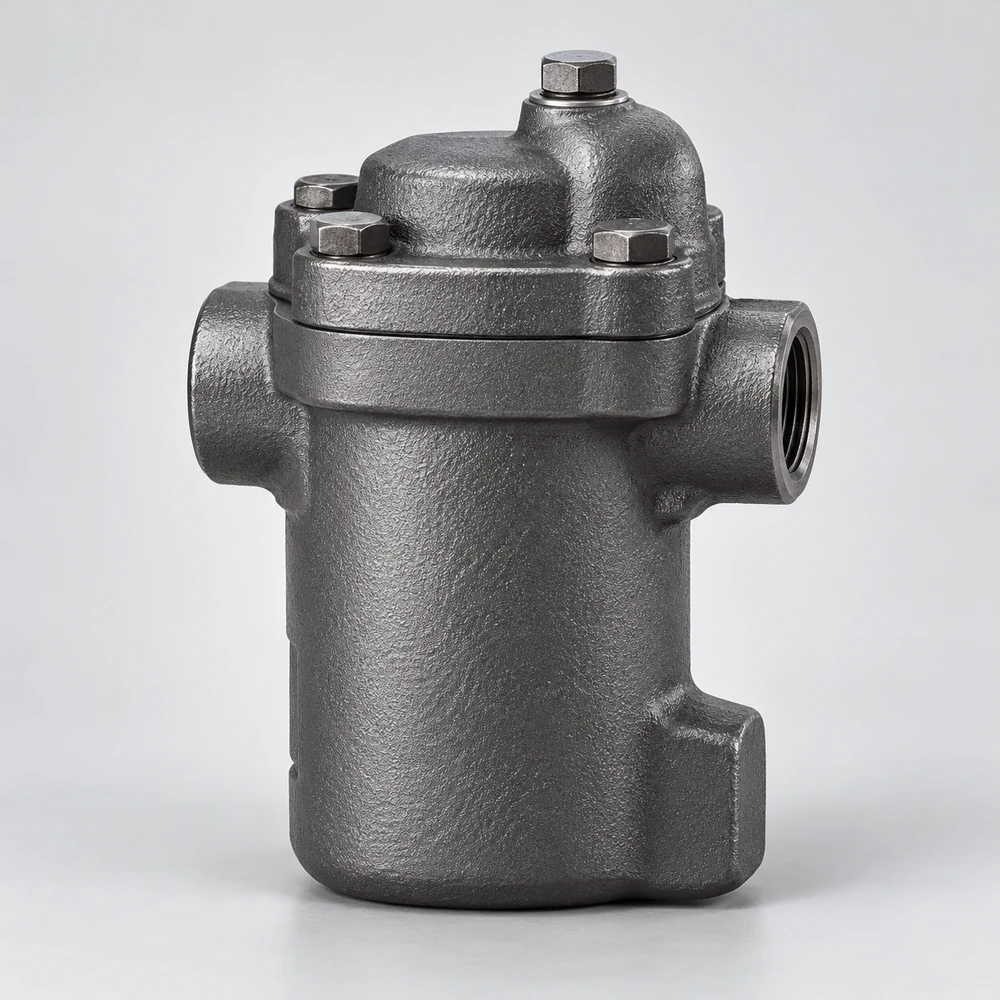
Series 880A inverted-bucket steam trap

The 880A steam-trap series uses an inverted bucket to discharge condensate. Steam collecting beneath the bucket raises it and closes the outlet; discharge resumes as buoyancy falls. Types 881A, 882A and 883A are listed within this family. The group has a listed maximum temperature of 350 °C. Select pressure, capacity and connections for the actual type and operating differential pressure.

Selected model specifications

Series880A
Types881A / 882A / 883A
MechanismInverted bucket
Maximum temperature350 °C

Models and configurations

Select a configuration. The family image changes only when the model has a distinct illustration.

Series 880A inverted-bucket steam trapSeries: 880A · Types: 881A / 882A / 883A · Mechanism: Inverted bucket · Maximum temperature: 350 °CThe 880A steam-trap series uses an inverted bucket to discharge condensate. Steam collecting beneath the bucket raises it and closes the outlet; discharge resumes as buoyancy falls. Types 881A, 882A and 883A are listed within this family. The group has a listed maximum temperature of 350 °C. Select pressure, capacity and connections for the actual type and operating differential pressure.
Stainless inverted-bucket steam trapSeries: 1000 · Installation: Vertical upward · Body: 304L stainless steel · Internals: 304 stainless steel · Valve and seat: Hardened chromium steel 440F · Connections: NPT / SW / FlangedThe Series 1000 inverted-bucket steam trap is described for vertical upward installation. This steam-condensate configuration has a 304L stainless-steel body, 304 internals and a hardened chromium-steel 440F valve and seat. The model group includes NPT screwed, socket-weld and flanged ends. Carbon steel is listed for standard flanges, with stainless steel as an alternative. Check-valve, large-vent and scrubbing-wire options address different operating conditions. Differential-pressure capability and discharge capacity depend on the selected model and orifice.
Horizontal inverted-bucket trapInstallation: Horizontal · Body: 304L stainless steel · Internals: 304 stainless steel · Valve and seat: Hardened chromium steel 440F · Connections: NPT / SW / Flanged · Freeze-drain option: Pop Drain: 1811 / 1822This inverted-bucket steam trap is described for horizontal installation and includes the 1800 model group. Condensate is discharged at saturation temperature, with each model's capacity dependent on differential pressure and orifice size. The materials table identifies a 304L body, 304 internals and a hardened 440F valve and seat. NPT, socket-weld and flanged connections are listed, with carbon-steel flanges and a stainless-steel alternative. Family options include a larger vent, scrubbing wire, insulation shell and freeze-protection drain; Pop Drain is specifically listed for models 1811 and 1822.
Universal-connection steam trapModels: 2010 / 2011 · Mounting: Connector, PPC, TVS or manifold; multiple positions · Body: 304L stainless steel · Valve and seat: Hardened chromium steel 440F · Listed admissible condition: 28 bar at 427 °C · Connector ends: NPT / SW / FlangedThe universal-connection steam trap is intended for a connector, PPC or TVS station, or manifold. The separate connector permits installation in different positions; models 2010 and 2011 are identified in the group. The trap uses a 304L body, 304 internals and a hardened 440F valve and seat. Connector ends may be NPT, socket weld or flanged, with carbon-steel or optional stainless-steel connector flanges. An admissible condition of 28 bar at 427 °C is listed for the group; discharge capacity still depends on differential pressure and orifice selection.
Thermodynamic disc trap with strainerPrimary series: CD60 · Mechanism: Thermodynamic disc with integral strainer · CD60 body and cap: Carbon steel · CD60 capsule and disc: Hardened stainless steel · Strainer and gasket: Stainless steel; graphite · Serviceability: Capsule and screen replaceable with body in lineThe CD60 thermodynamic trap uses a control disc and integral strainer. Incoming condensate lifts the disc from the inlet; steam then changes velocity and pressure in the control chamber and closes the disc. Controlled chamber bleeding allows the next opening cycle. The operating capsule and strainer screen can be renewed without removing the body from the line: four cover bolts are removed and the capsule unscrewed. CD60 materials include a carbon-steel body and cap, hardened stainless-steel capsule and disc, stainless-steel strainer and graphite gasket. CD33S uses the same operating principle, but its limits should not be assumed identical to CD60.
Float and thermostatic steam trapType: Float & Thermostatic · Installation: Horizontal · Body: A216 WCB · Internals: 304 stainless steel · Vent: Stainless steel and phosphor bronze · Listed admissible condition: 31 bar at 338 °CThe float-and-thermostatic trap is described for horizontal installation and steam-condensate discharge. A closed float controls condensate discharge, while a thermostatic vent handles air and gas release; this construction differs from an inverted-bucket trap. The body is A216 WCB cast steel with 304 stainless-steel internals. The vent uses stainless steel and phosphor bronze. An admissible condition of 31 bar at 338 °C is listed, and discharge capacity varies with differential pressure and orifice selection. L and M types are also described in cast iron and should be distinguished from the steel-body version.
Condensate pumping trapMotive fluid: Steam or compressed air · Electrical supply: Not required · Body and cap: Steel or cast iron, depending on version · Mechanism and valves: Stainless steel · Stated back-pressure capability: Up to 8.5 bar · Family capacity: Up to 5000 kg/hThe pumping trap handles condensate from heat exchangers or heating coils when equipment pressure falls below the condensate-return pressure. It is also described for draining equipment under vacuum into an atmospheric or back-pressured return. Steam or compressed air provides the motive force, so no electrical supply is required. The arrangement avoids the cavitation and mechanical-seal wear associated with conventional pumping. Steel and cast-iron body/cap versions are described with stainless-steel mechanisms and valves. The family lists capacity up to 5000 kg/h and back pressure up to 8.5 bar; the selected duty point must match the motive-fluid and return-line conditions.
Series 200A inverted-bucket steam trapSeries: 200A · Types: 213A / 214A / 215A / 216A · Mechanism: Inverted bucket · Maximum operating pressure: 32 bar · Maximum temperature: 350 °CThe 200A series uses an inverted bucket to discharge condensate while retaining steam. A chamber body with a separate cover is shown, with types 213A, 214A, 215A and 216A in the family. The group lists operating pressure up to 32 bar and maximum temperature of 350 °C. Select size, connections and discharge capacity for the actual differential pressure; a capacity figure must not be applied to every type independently of operating conditions.
Series 300 and 400 inverted-bucket steam trapsSeries: 300 / 400 · Mechanism: Inverted bucket · Series 300 limits: Up to 46 bar / 400 °C · Series 400 limits: Up to 70 bar / 510 °C · Listed material options: Series 300: A105; Series 400: A182 F11The 300 and 400 inverted-bucket series have a tall cylindrical body with connections near the upper part. The 300 series lists types 310–316, while the 400 series lists 411, 413, 415 and 416. The upper listed operating envelope is up to 46 bar and 400 °C for series 300, and up to 70 bar and 510 °C for series 400. Select the material and discharge capacity of the actual type; the two series do not share identical limits.
Series 5100 and 6100 high-pressure steam trapsSeries: 5100 / 6100 · Types: 5133 / 5155 / 6155 · Mechanism: Inverted bucket · Pressure depending on type: Up to 190 bar · Maximum temperature: 566 °C · Material option: A182 F22This inverted-bucket family is listed for higher pressure and temperature service. It has a slender body and bolted cover arrangement, with types 5133, 5155 and 6155. The inverted-bucket mechanism controls condensate discharge cyclically. The listed types have a maximum temperature of 566 °C and operating pressure up to 190 bar, depending on the type. A182 F22 is one listed material. Select capacity, material and connections for the actual model and differential pressure.
CD33S thermodynamic steam trap with strainerType: CD33S · Mechanism: Thermodynamic disc · Body and cap: Chromium-alloy steel · Disc and strainer: Stainless steel · Maximum limits: 41 bar / 400 °C · Minimum operating pressure: 0.24 barThe CD33S combines a thermodynamic disc mechanism with an internal strainer. Its section shows a body and strainer passage different from the replaceable-capsule CD60 construction, while using the same general cyclic condensate-discharge principle. The body and cap are chromium-alloy steel, with a stainless-steel disc and strainer. Listed limits are maximum allowable pressure of 41 bar, maximum temperature of 400 °C and minimum operating pressure of 0.24 bar.