cogvalveفارسی
Strainers
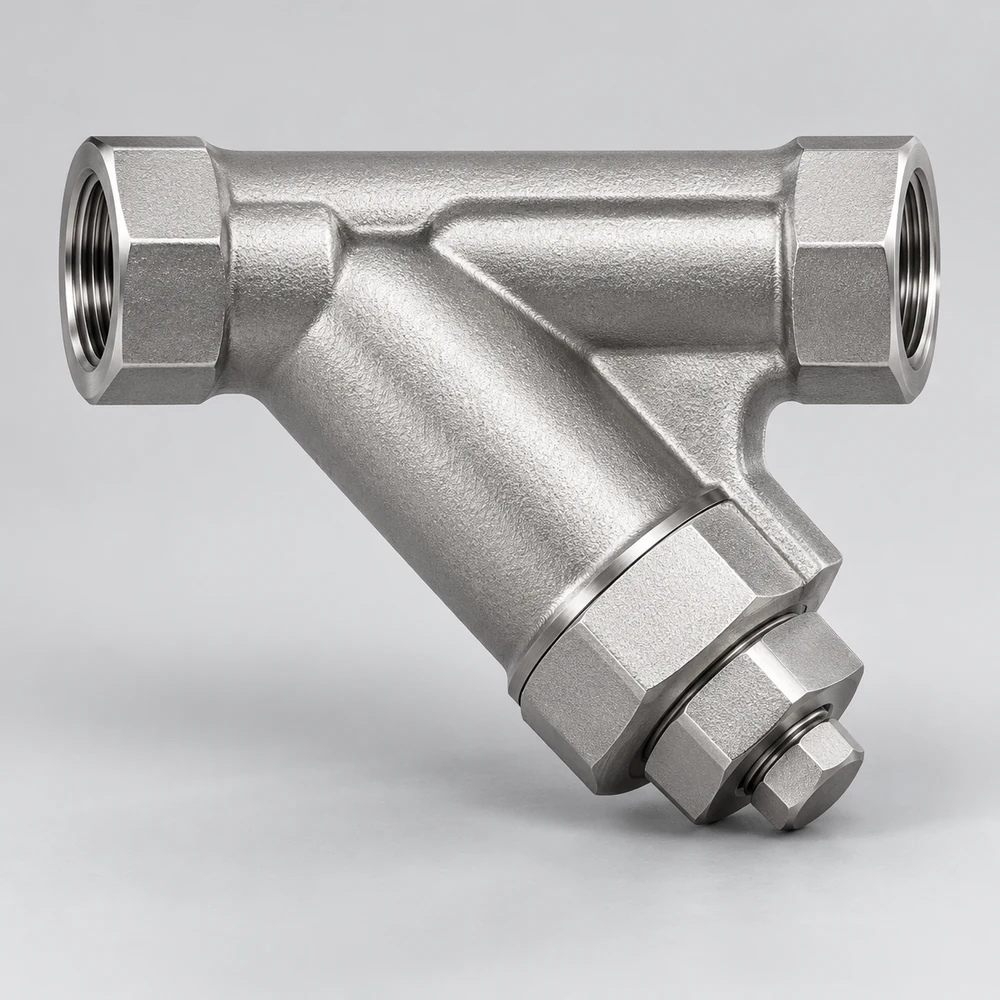
AI-generated product illustration. Final details are confirmed against the order specification.

Strainers

6 models in this family

Review the listed models and configurations in this family, then select one for a quotation request.

Selected model

Threaded Y-strainer

The screwed or socket-weld Y-strainer separates solid particles using a screen in its side branch. Body materials are carbon steel or stainless steel, with a matching-material cover. A screwed cover is the standard arrangement, with a bolted cover also described. The specification lists a 304 or 316 stainless-steel micro-expanded-metal screen with 0.8 mm openings, a 316/graphite spiral-wound gasket and a 1/4-inch NPT drain plug. Threaded or SW ends are the main choices, with BW as an alternative. Classes 800, 1500 and 2500 are tabulated for the group; size and screen area depend on the selected model.

Selected model specifications

BodyCarbon steel or stainless steel
ConnectionsThreaded / SW; optional BW
Screen304 / 316 stainless steel; 0.8 mm
Gasket316/graphite spiral wound
Drain1/4 in NPT
Classes800 / 1500 / 2500

Models and configurations

Select a configuration. The family image changes only when the model has a distinct illustration.

Threaded Y-strainerBody: Carbon steel or stainless steel · Connections: Threaded / SW; optional BW · Screen: 304 / 316 stainless steel; 0.8 mm · Gasket: 316/graphite spiral wound · Drain: 1/4 in NPT · Classes: 800 / 1500 / 2500The screwed or socket-weld Y-strainer separates solid particles using a screen in its side branch. Body materials are carbon steel or stainless steel, with a matching-material cover. A screwed cover is the standard arrangement, with a bolted cover also described. The specification lists a 304 or 316 stainless-steel micro-expanded-metal screen with 0.8 mm openings, a 316/graphite spiral-wound gasket and a 1/4-inch NPT drain plug. Threaded or SW ends are the main choices, with BW as an alternative. Classes 800, 1500 and 2500 are tabulated for the group; size and screen area depend on the selected model.
Flanged Y-strainerBody: Carbon steel, low-temperature steel or stainless steel · Cover: Bolted · Screen: 304 / 316 stainless perforated plate; 0.8 mm · Flanged ends: ASME B16.5 · BW ends: ASME B16.25 · Main classes: 150 / 300 / 600The flanged Y-strainer has a bolted cover for screen access. Carbon steel, low-temperature steel and stainless steel are listed for the body, with a compatible cover material. A 316/graphite spiral-wound gasket seals the cover. The screen is perforated 304 or 316 stainless-steel plate with 0.8 mm openings. Woven wire cloth combined with the plate and a special drain assembly using pipe, flange and valve are options. ASME B16.5 flanged or ASME B16.25 butt-weld ends are described in Classes 150, 300 and 600; higher classes require a separate configuration.
Cast steel T-strainerType: Cast-steel T-strainer · Size range: NPS 4–24 · Classes: 150 / 300 / 600 · Basket: 304 / 316 stainless steel; 3 mm perforations · Connections: ASME B16.5 flanges / ASME B16.25 BW · Gasket: 316/graphite spiral woundThe cast-steel T-strainer holds a basket in the branch perpendicular to the main flow path, with access through a bolted cover flange. Body options include carbon steel, low-temperature steel and stainless steel, with a 316/graphite spiral-wound cover gasket. The basket is described as 304 or 316 stainless-steel perforated plate with 3 mm openings and a bath-tub shape. Additional wire cloth, basket reinforcement and special drains are options. The range is 4–24 inches in Classes 150, 300 and 600, with flanged or butt-weld ends.
Temporary cone strainerShape: Cone · Size range: NPS 1 1/2–24 · Classes: 150 / 300 · Plate: 304 stainless steel; 1.5 mm · Perforations: 3 mm · Mounting: Between flanges; near protected equipment · Filtration ratio: 150%The temporary cone strainer is intended for short test and start-up periods to capture debris left in a pipeline. A flat mounting face fits between flanges, while the perforated cone provides filtering area inside the pipe. The standard construction uses 1.5 mm thick 304 stainless-steel plate with 3 mm perforations. The size range is 1.5–24 inches in Classes 150 and 300. Wire cloth inside or outside the plate, according to flow direction, and a double-cone version for higher flow are options. The stated standard filtration ratio is 150%.
Temporary truncated-cone strainerShape: Truncated cone · Size range: NPS 1 1/2–24 · Classes: 150 / 300 · Standard plate: 304 stainless steel; 1.5 mm; 3 mm perforations · Optional reinforcement: Cross or lateral reinforcement · Duty: Short-term testing and start-upThe temporary truncated-cone strainer protects equipment from residual debris during pipeline testing and start-up. Unlike a full cone, it has a shortened end; reinforcement crosses or lateral reinforcement are specifically described for this form. A flat mounting face is inserted between flanges. The family covers 1.5–24 inches and Classes 150 and 300, using 1.5 mm thick 304 stainless-steel plate with 3 mm perforations. Additional wire cloth and alternative filtration ratios are options, with cloth position matched to flow direction. The strainer is defined for short operating periods.
Temporary flat strainerShape: Flat · Mounting: Between flanges · Size range: NPS 1 1/2–24 · Classes: 150 / 300 · Standard plate: 304 stainless steel; 1.5 mm; 3 mm perforations · Duty: Short-term testing and start-upThe temporary flat strainer places a filtering plate between two flanges for short test or start-up periods. Compared with a cone, the flat form occupies less axial space; open area and pressure drop must suit the equipment being protected. The standard family construction uses 1.5 mm thick 304 stainless-steel plate with 3 mm perforations. Temporary forms are listed in sizes 1.5–24 inches and Classes 150 and 300. Additional wire cloth and serrated or RTJ connection faces are special options. The start-up plan should define the strainer's disposition after its temporary protection duty.